Paying in Korea with a foreign card in 2026: what works and what doesn't
Your card will work at most counters. It's the apps, kiosks and booking sites that catch visitors out, and that's where you need a plan.
Quick answer
- Shops, restaurants, convenience stores: a foreign Visa or Mastercard works almost everywhere you pay at a counter.
- Korean apps: Kakao Pay and Naver Pay don't open accounts for tourists. Booking and waitlist apps that need a Korean phone number are the most common dead end.
- Subway: foreign cards now buy passes and tickets at 440 Seoul machines, but you still can't tap a card at the gate.
- Carry some cash: you need won to top up T-money and for some market stalls.
- Card at counters
- Works almost everywhere
- Kakao Pay, Naver Pay
- Not available to tourists
- Tap card at subway gate
- Not in Seoul yet; Jeju yes (Visa)
- Tipping
- Not expected; service is included
Korea is one of the easiest places in the world to pay by card, which is exactly why the exceptions are so annoying. You’ll tap your Visa at a convenience store without a second thought, then get stuck an hour later because a restaurant’s waitlist wants a Korean phone number, or a ticket site won’t take any card issued abroad.
When Yanolja Research analyzed more than 7,000 Reddit posts by visitors to Korea, payment methods made up 11.5% of the complaints, just behind sign-up and verification problems. So it’s not just you.
The good news is that the problems are predictable. Here’s where a foreign card works, where it doesn’t, and what to use instead.
The short version
Pay at counters with your card. Carry a little cash. Use a transit card or phone for the subway. For anything inside a Korean app, expect friction, and check our list below before you rely on it.
Where your card works without fuss
Visa and Mastercard are accepted almost everywhere you pay in person: convenience stores, cafes, restaurants, department stores, Olive Young, most taxis and hotels. Foreign Visa spending in Korea grew 26% in a year to March 2025, and contactless payments (tapping instead of inserting) made up 15% of those transactions, up from 6% the year before. More terminals take tap payments every year.
Problems at counters do happen, mostly at small shops where an older card reader fails to connect, or at the occasional merchant that avoids foreign cards because of the fees. If a card gets declined, try inserting it instead of tapping, then try a second card. Bringing two cards from different networks is the simplest insurance you can buy.
Don’t tip. It isn’t expected, and by law menu prices already include tax and service.
Where it gets difficult
The trouble is almost always online or inside an app, not at a counter.
- Kakao Pay and Naver Pay. These are the two big Korean payment apps, and neither lets tourists open an account. Kakao Pay’s newer Global Home service is for foreign residents, not visitors.
- Waitlists and reservations. Many popular restaurants use a tablet at the door to manage the queue, and many of those need a Korean phone number to text you when your table is ready.
- Some booking and ticket sites. A tourist quoted by Korea JoongAng Daily couldn’t use a travel card to book movie tickets, which needed a Korean card or bank account, and ended up buying at the cinema in person.
- Apple Pay. It only works where the shop has an NFC terminal, and many don’t. Treat it as a backup, not your main way to pay.
The subway and buses
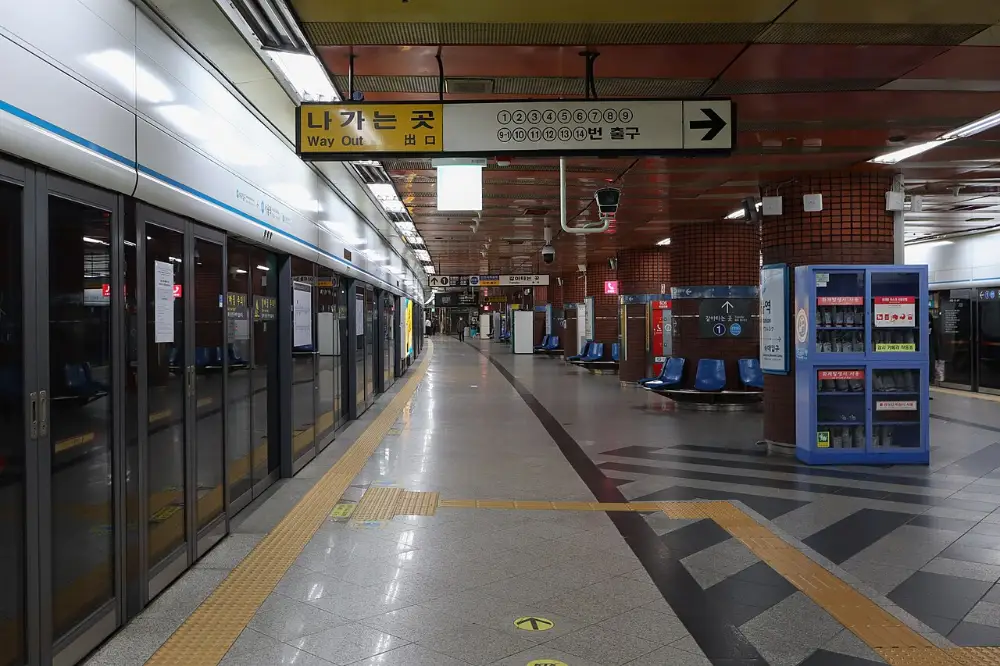
Since March 17, 2026, 440 new ticket machines across 273 stations on Seoul subway Lines 1 to 8 accept Visa, Mastercard and other overseas cards. You can use them to buy single tickets and Climate Card passes, with a fee of around 3.7% on foreign cards. They don’t top up T-money, which is still cash only.
What you still can’t do in Seoul is tap a foreign credit card at the gate. That’s planned, but not before 2027. Jeju is the exception: you can already tap an overseas Visa card on Jeju’s public transport.
If you have an iPhone, the Tmoney app now has a sign-up option for foreigners. You can top up with Mastercard, Amex or UnionPay (Visa wasn’t supported at launch), then tap your phone at the gates. Our transit card guide compares all the options.
Taxis, trains and food delivery
Taxis. Most taxis take cards when you pay the driver. To book one from an app, k.ride, Kakao Mobility’s app for visitors, accepts overseas cards and doesn’t need a Kakao account. If you use Alipay or another Asian wallet, more than 70,000 Seoul taxis accept it through Alipay+.
KTX trains. Buying at station machines with a foreign card has been unreliable. Since late April 2026 you can book live Korail train seats through Klook, in more than 20 languages and 40 currencies.
Food delivery. Baemin, Korea’s biggest delivery app, now accepts non-Korean phone numbers, overseas credit cards, foreign cards in Apple Pay, and Alipay and WeChat Pay. It’s the one delivery app we’d point a visitor to.
Wallets from home
If you use Alipay, AlipayHK, Touch ‘n Go, GCash, PayPay or one of about 20 other Asian wallets, you may not need a card at all. Through Alipay+, these wallets work at more than 2 million Korean merchants. Look for the Alipay+ sign at the counter.
Cash: how much and where
You’ll need some won for:
- Topping up a T-money card at convenience stores and station machines
- Market stalls and street food in some places
- Anything that goes wrong with your card at a bad moment
When you withdraw from an ATM or pay by card and the screen offers to charge you in your home currency, choose won (KRW). Converting at the machine almost always costs more than letting your own bank do it.
A prepaid travel card is another option. WOWPASS lets you load foreign cash at kiosks and pay like a debit card. It costs 5,000 won to register, with no fee to top up or pay, and 1,000 won per cash withdrawal.
Shopping and tax refunds
At stores that offer immediate tax refunds, the refund comes off the price at the till when you show your passport. The limit is 1 million won per purchase and 5 million won per trip. Keep your passport with you when you go shopping, since you’ll need it at the counter.
What we’d do
Bring two cards on different networks, ideally one with no foreign transaction fees. Get a small amount of won when you land for T-money and markets. Set up T-money on your phone if you have an iPhone and a supported card. Install Baemin if you’ll want delivery, and k.ride if you’ll want app taxis.
Then stop worrying about it. At counters, which is where most of your spending happens, your card will just work. Save our phrase cards for the moment you need to ask “Can I pay by card?” in Korean.
Questions people ask
Do I need cash in Korea?
A little. Cards work almost everywhere you pay at a counter, but T-money top-ups are cash only and some market stalls only take cash. Most visitors get by with a small amount of won.
Can tourists use Kakao Pay or Naver Pay?
No. As of May 2026 neither service supports accounts for foreign tourists, and neither had announced plans to. Kakao Pay's Global Home service is for foreign residents.
Does Apple Pay work in Korea with a foreign card?
Only where the shop has an NFC terminal, and many don't, so don't rely on it as your only way to pay. In the Tmoney app, foreigners can top up with Mastercard, Amex or UnionPay through Apple Pay and use T-money in Apple Wallet.
Can I order food delivery as a tourist?
Yes, on Baemin. It accepts non-Korean phone numbers, overseas credit cards, Alipay and WeChat Pay, and foreign cards in Apple Pay.
Should I tip in Korea?
No. Tipping isn't part of the culture, and by law menu prices already include tax and service charges.
Can I use Alipay in Korea?
Yes. Through Alipay+, 21 overseas wallets including Alipay, AlipayHK, Touch 'n Go, GCash and PayPay work at more than 2 million Korean merchants and in over 70,000 Seoul taxis.
How we checked this
Change log
- First published.
Sources
- Korea JoongAng Daily: declined cards, reservation hassles and digital barriers (2026-05-12)
- Korea Times: why Korea's payment systems leave tourists frustrated (2025-04-23)
- Korea Times: foreigner card spending and contactless growth (2025-10-01)
- Korea Herald: overseas cards accepted at Seoul subway ticket machines (2026-03-16)
- Korea Herald: Jeju lets overseas Visa cards pay for transit (2026-04-13)
- Korea JoongAng Daily: Apple Pay Tmoney for foreigners (2026-03-19)
- Korea JoongAng Daily: Seoul and Baemin make food delivery easier for tourists (2026-07-29)
- Korea Times: Alipay+ demand in Korea (2025-12-09)
- Korea Herald: Kakao Pay launches Global Home for foreign residents (2025-11-12)
- Korea JoongAng Daily: Kakao Mobility's k.ride app for foreign travelers (2024-06-04)
- Korea Herald: Klook adds live Korail train booking (2026-05)
- Korea JoongAng Daily: tax refund limits for tourists doubled (2023-11-27)
- Korea Times: why tipping culture remains controversial in Korea (2025-08-07)
Spotted something out of date? Tell us and we'll re-check it.
Read or use next
-
 T-money vs WOWPASS vs Climate Card: which transit card to get in 2026
Three cards, one tap at the gate. Here's which one saves you money, depending on how you'll actually move around.
T-money vs WOWPASS vs Climate Card: which transit card to get in 2026
Three cards, one tap at the gate. Here's which one saves you money, depending on how you'll actually move around.
- Korea trip checklistA tick-box list that remembers your progress on this device.
- Show-on-your-phone Korean phrase cardsTap a phrase and it fills your screen, ready to show.
-
 3 days in Seoul for first-timers: a realistic itinerary
Three days is enough for Seoul's highlights if you stop crossing the city twice a day. Group by neighborhood and the subway time mostly disappears.
3 days in Seoul for first-timers: a realistic itinerary
Three days is enough for Seoul's highlights if you stop crossing the city twice a day. Group by neighborhood and the subway time mostly disappears.