What to do in Seoul when it rains
Seoul is surprisingly good in the rain, as long as you plan around a few big indoor anchors and the miles of shopping corridors under the streets.
Quick answer
- Best single rainy-day pick: the National Museum of Korea. Permanent galleries are free, it's open late on Wednesdays and Saturdays, and an underground passage links it to Ichon Station.
- Pair it with: the War Memorial of Korea nearby (free, closed Mondays), or cross the river to The Hyundai Seoul or COEX for food and browsing.
- Walk without an umbrella: Seoul's 25 city-run underground arcades, such as Gangnam Station and the Express Bus Terminal, connect straight to the subway.
- Light rain only: palaces are lovely and quieter in drizzle. Check the closing day first, since Gyeongbokgung shuts on Tuesdays and Changdeokgung on Mondays.
- Monsoon (normal)
- About June 25 to July 26 in central Korea
- National Museum
- Free, 9:30 a.m. to 5:30 p.m. (9 p.m. Wed, Sat)
- Starfield Library
- Free, 10:30 a.m. to 10 p.m. daily
- Underground arcades
- 25 centers, about 2,800 shops
You planned a palace morning and a Han River evening, and the forecast has turned into a wall of blue raindrops. Or it’s early August, well past 30 degrees and sticky, and walking between sights feels like wading. Either way you need a day that happens mostly under a roof, ideally without spending half of it in taxis.
Seoul handles this better than most cities. It has a handful of huge, free or cheap indoor sights, and a lot of the city’s shopping lives underground, wired straight into subway stations.
The short version
Build the day around one big anchor, then add something nearby. The National Museum of Korea is the best rainy-day anchor in the city: the permanent galleries are free, there’s enough for a full day, and you can reach it from Ichon Station through an underground passage. The War Memorial of Korea is two stops up Line 4 and also free. If you’d rather shop and eat, go to COEX in Gangnam (Starfield Library is inside) or The Hyundai Seoul in Yeouido, both connected to the subway. Save palaces for light drizzle, when they’re quieter and quite beautiful, and keep a sauna in reserve for the evening.
When Seoul’s rain actually hits
Most of Seoul’s heavy rain falls in the summer monsoon, called jangma. The Korea Meteorological Administration’s normal dates for the central region, which includes Seoul, are about June 25 to July 26. In 2026 it started late, on July 1, and ended on schedule on July 26. Within that window it doesn’t rain every day, but when it does it can pour for hours, and short, violent downpours are common.
August is usually the hottest and most humid stretch after the monsoon ends, and an indoor plan is just as useful then. Spring and autumn rain tends to be lighter and shorter. If you’re still choosing dates, our guide to the best time to visit Korea goes month by month.
Museums that can fill the whole day
- National Museum of Korea 강추 Worth it. The country’s main museum, in Yongsan, with a huge permanent collection from prehistory to the Joseon dynasty. Permanent galleries and the Children’s Museum are free; some special exhibitions charge. It opens at 9:30 a.m. and closes at 5:30 p.m. on Monday, Tuesday, Thursday, Friday and Sunday, and stays open until 9 p.m. on Wednesday and Saturday (last entry 30 minutes before closing). It closes on January 1, Lunar New Year’s Day and Chuseok, and the galleries also close on the first Monday of March, June, September and December.
- War Memorial of Korea 강추 Worth it. A large museum on the Korean War and Korea’s military history, with aircraft and armored vehicles outside and extensive indoor halls. Admission is free (some exhibitions charge), and it opens 9:30 a.m. to 6 p.m., closed on Mondays. If a public holiday falls on a Monday, it closes the next day instead. It’s a short walk from exits 11 and 12 of Samgakji Station (Lines 4 and 6).
Getting to the National Museum in the rain is easy: take Line 4 or the Gyeongui-Jungang Line to Ichon Station. Exit 2 is the usual route, about a 400 m walk, but an underground walkway called Museum Nadeulgil connects the station toward the museum, which is exactly what you want on a wet day.
Be ready for crowds. The museum had about 6.5 million visitors in 2025, one of the highest totals of any museum in the world, and Korea JoongAng Daily reported people queuing before opening. Rainy days and school holidays push numbers up further. Arrive at 9:30, or use the Wednesday and Saturday late evenings, which are calmer.
Admission may change. The museum has been free since 2008, and in March 2026 Kyunghyang Shinmun reported that the government was seriously considering charging again from 2027, with an online reservation system being tested in the first half of 2027. Nothing was final at the time of writing, so check before you go next year.
Malls built for a wet day
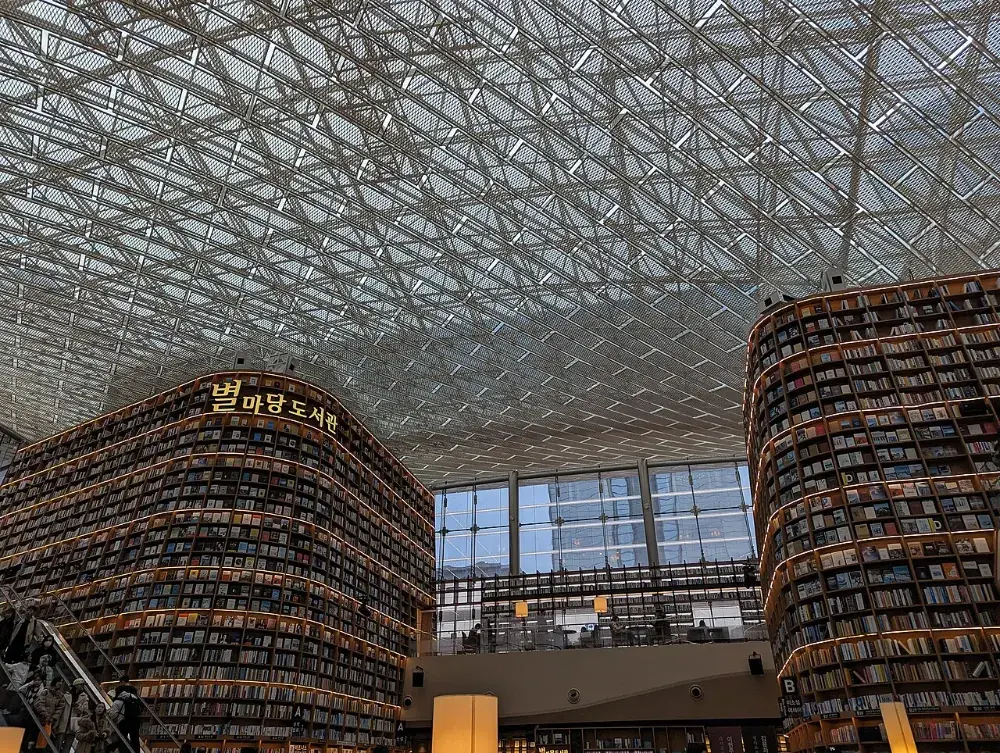
Starfield COEX Mall and Starfield Library 케바케 Depends. COEX in Gangnam is a vast mall almost entirely on one underground floor, directly connected to Samseong Station (Line 2) and Bongeunsa Station (Line 9). Starfield Library, the two-story wall of bookshelves in the middle, is free and open daily from 10:30 a.m. to 10 p.m. It holds roughly 50,000 books and magazines you can sit and read. It’s photogenic and worth 20 minutes if you’re in Gangnam anyway. The top shelves are decorative, it’s busy, and as a reading space it’s more lobby than library, so don’t cross Seoul just for it. The rest of COEX, with its restaurants, the aquarium and the shops, is what makes the trip worthwhile on a wet day.
The Hyundai Seoul 강추 Worth it. Seoul’s big department store in Yeouido, opened in February 2021, and a good place to spend a rainy afternoon even if you don’t buy anything. The fifth floor holds Sounds Forest, an indoor garden with trees and seating of about 3,300 square meters. The basement food hall is one of the best in the city. Hours are 10:30 a.m. to 8 p.m. Monday to Thursday and 10:30 a.m. to 8:30 p.m. Friday to Sunday, with the food court open until 10 p.m. It closes on certain days each month that change, so check the Hyundai Department Store website. Basement 2 links underground to IFC Mall and the subway at Yeouido Station.
If you shop seriously at either, carry your passport. Our tax refund guide explains the instant refund at the till.
Underground shopping arcades
Below the streets, Seoul Facilities Corporation runs 25 underground shopping centers with about 2,800 shops between them. They’re mostly clothes, accessories, phone cases and cosmetics at modest prices. Shopping isn’t the main reason to use them, though. They link subway exits and let you cover real distance without an umbrella.
| Arcade | Shops | Hours | Closed |
|---|---|---|---|
| Express Bus Terminal (often called Goto Mall) | 620 | 10 a.m. to 10 p.m. | Open year-round except some holidays |
| Gangnam Station | 212 | 10 a.m. to 10 p.m. (passageways 24 hours) | Open year-round except some holidays |
| Myeongdong and Myeongdong Station | 61 and 70 | 9 a.m. to 10 p.m. | Open year-round except some holidays |
| Hoehyeon (near Namdaemun Market) | 225 | 9 a.m. to 10 p.m. | 1st and 3rd Sundays |
| Euljiro | 216 | 9 a.m. to 10 p.m. | Sundays and public holidays |
| Jamsil Station | 139 | 10 a.m. to 10 p.m. | 1st and 3rd Mondays |
Hours are for the shops. At Gangnam Station the corridors stay open 24 hours. The Express Bus Terminal arcade is the biggest and the one most visitors enjoy browsing. The Euljiro arcade is handy in the old center, but it’s quiet on Sundays and holidays when the shops are shut. Naver Map shows underground exits and passages, and our Naver Map guide explains how to read them in English.
Saunas and covered markets
A jjimjilbang (Korean bathhouse and sauna) is the classic answer to a cold, wet evening: hot pools, heated floors, cheap snacks, and you can stay for hours. It’s less appealing in midsummer heat, unless you just want air conditioning and a nap. We’ve written a separate, honest take on whether a jjimjilbang is worth it, including the etiquette.
Traditional markets are another good rainy-day dinner. Gwangjang Market in Jongno is mostly roofed over, and its food alley of stall counters (mung bean pancakes, gimbap, noodles) works fine in a downpour. It’s had its share of overcharging complaints, and in late 2023 Seoul announced rules requiring food stalls to list serving weights next to their prices, checked by undercover inspectors. Some stalls are cash only, so carry some won.
Palaces in the rain
Palaces aren’t only a fair-weather plan. In light rain the courtyards empty out, the stone gets a sheen, and the roofs and eaves give you cover between halls. In a real downpour, or under a typhoon warning, they’re miserable, since most of the ground is open courtyard.
- Gyeongbokgung: adults 3,000 won, free for foreign visitors 18 and under or 65 and over. It closes on Tuesdays. Hours are 9 a.m. to 6 p.m. in September and October, 9 a.m. to 5 p.m. from November to February, and 9 a.m. to 6:30 p.m. in summer, with last entry an hour before closing.
- Changdeokgung: 3,000 won, closed Mondays. The Secret Garden is a separate 5,000 won ticket for adults on top of the palace ticket. It’s mostly outdoors on paths, so it suits drizzle better than heavy rain.
- Deoksugung and Changgyeonggung: both small and close to the subway, both closed on Mondays, and admission was 1,000 won at last check. Deoksugung sits next to City Hall Station, so it fits between showers.
Our 3-day Seoul itinerary can be reshuffled so a palace lands on your driest morning.
Rainy-day mistakes that catch visitors out
Forgetting the closing days. The two weekly closures that catch people out are the War Memorial and Changdeokgung on Mondays, and Gyeongbokgung on Tuesdays. Rain doesn’t make anyone open on their day off.
Taking a taxi in a downpour at rush hour. Everyone else has the same idea, apps struggle to find a car, and traffic slows. The subway is faster and you can often stay underground most of the way.
Treating Starfield Library as a full outing. It’s a nice photo and a short stop inside a big mall. Combine it with COEX’s food and shops, or with Bongeunsa temple next door when the rain eases.
Arriving at the National Museum at noon on a wet weekend. It’s free, central and dry, so half of Seoul has the same plan. Go at opening or on a late Wednesday or Saturday evening.
Wearing canvas shoes. Seoul’s rain comes in heavy bursts and pavements flood at the edges. Convenience stores sell umbrellas and rain ponchos at every corner, so don’t pack a big one, but wear shoes that can get wet.
What we’d do
One wet day, first trip: National Museum of Korea at 9:30 a.m. via the underground passage from Ichon Station, then the War Memorial in the afternoon if it isn’t a Monday. Dinner in a covered market or a jjimjilbang evening.
Shoppers: The Hyundai Seoul for lunch and Sounds Forest, then cross to Gangnam for COEX and Starfield Library, and finish in the Express Bus Terminal arcade.
Families with kids: National Museum (the Children’s Museum is free, and you can book a session online) or the War Memorial, where kids tend to love the tanks and planes outside if the rain lets up.
Monsoon or August heat, several days: put the outdoor sights first thing in the morning, go indoors from late morning to late afternoon, and save neighborhoods and the river for the evening, when it’s cooler.
Light drizzle: go to a palace. Gyeongbokgung or Changdeokgung in soft rain, with half the usual crowd, can be the best version of them.
Questions people ask
When is monsoon season in Seoul?
The Korea Meteorological Administration's normal dates for central Korea, which includes Seoul, run from about June 25 to July 26. In 2026 it started on July 1 and ended on July 26. August is usually the hottest stretch afterwards.
Is the National Museum of Korea really free?
Yes, the permanent galleries and the Children's Museum are free. Some special exhibitions charge a fee. The government has been discussing reintroducing admission charges, so check before you go in 2027.
Can I visit palaces in the rain?
Yes. Palaces stay open in ordinary rain, and the deep eaves of the halls give some cover. In heavy downpours or typhoon warnings, an indoor plan is safer.
Which museums are closed on Mondays?
The War Memorial of Korea closes every Monday. The National Museum of Korea opens on Mondays, but its permanent and special galleries close on the first Monday of March, June, September and December.
Where can I walk underground in Seoul?
The city-run arcades at Gangnam Station, the Express Bus Terminal, Myeongdong, Euljiro and Jongno all link to subway stations. Gangnam Station's passageways stay open around the clock, though the shops close at 10 p.m.
How we checked this
Change log
- First published.
Sources
- National Museum of Korea (official): visitor information (checked 2026-10-09)
- Korea JoongAng Daily: National Museum of Korea to open, close 30 minutes earlier from March (checked 2026-10-09)
- Kyunghyang Shinmun: National Museum of Korea admission fee under review (2026-03-30)
- National Hangeul Museum: directions via Ichon Station (checked 2026-10-09)
- K-Trip Tips (Korea tourism data): War Memorial of Korea (2022-09-14)
- Wikipedia: Samgakji Station (checked 2026-10-09)
- Seoul Media Hub: Starfield Library at COEX (2020-07-22)
- K-Trip Tips (Korea tourism data): Starfield Library (2025-12-16)
- Wikipedia: Starfield COEX Mall (checked 2026-10-09)
- K-Trip Tips (Korea tourism data): The Hyundai Seoul (2026-08-11)
- inews24: The Hyundai Seoul opens in Yeouido (2021-02-24)
- Seoul Facilities Corporation: underground shopping centers overview (checked 2026-10-09)
- Seoul Facilities Corporation: underground shopping center FAQ (hours and closing days) (checked 2026-10-09)
- Seoul Facilities Corporation: Gangnam Station underground shopping center (checked 2026-10-09)
- K-Trip Tips (Korea tourism data): Gyeongbokgung Palace (2026-09-23)
- K-Trip Tips (Korea tourism data): Changdeokgung Palace and Secret Garden (2026-06-29)
- Seoul Media Hub: night openings at Deoksugung and Changgyeonggung (2022-05-19)
- Segye Ilbo: central region monsoon ends July 26 (2026-07-27)
- Korea JoongAng Daily: Seoul to introduce measures to curb exorbitant pricing at Gwangjang Market (2023-12-04)
Spotted something out of date? Tell us and we'll re-check it.
Read or use next
-
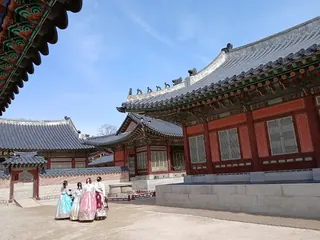 3 days in Seoul for first-timers: a realistic itinerary
Three days is enough for Seoul's highlights if you stop crossing the city twice a day. Group by neighborhood and the subway time mostly disappears.
3 days in Seoul for first-timers: a realistic itinerary
Three days is enough for Seoul's highlights if you stop crossing the city twice a day. Group by neighborhood and the subway time mostly disappears.
-
 Is a jjimjilbang worth it? An honest guide to Korean saunas
Cheap, warm, very Korean and more relaxing than it sounds. The nude bath part is real, though, and the famous old spas in the guidebooks have mostly gone.
Is a jjimjilbang worth it? An honest guide to Korean saunas
Cheap, warm, very Korean and more relaxing than it sounds. The nude bath part is real, though, and the famous old spas in the guidebooks have mostly gone.
-
 Best time to visit Korea: a season-by-season guide with real dates
Spring and autumn are the easy answer, but each has its own catch. Here's what the weather, the flowers and the holiday calendar actually look like month by month.
Best time to visit Korea: a season-by-season guide with real dates
Spring and autumn are the easy answer, but each has its own catch. Here's what the weather, the flowers and the holiday calendar actually look like month by month.
-
 How to use Naver Map (and KakaoMap) in English
Google Maps will get you onto the right subway line. It won't walk you to the door. That's what Naver Map is for.
How to use Naver Map (and KakaoMap) in English
Google Maps will get you onto the right subway line. It won't walk you to the door. That's what Naver Map is for.